Популярное
Журнал Радиоконструктор

Электроника, электрика

Журнал Радиоконструктор

Журнал Радиоконструктор

Электроника, электрика

Электроника, электрика
Электроника, электрика
Телевидение и Радио
Начинающему радиолюбителю

Программы для радиолюбителя
Электроника, электрика

Микроконтроллеры
Электроника, электрика
Учебники

Учебники

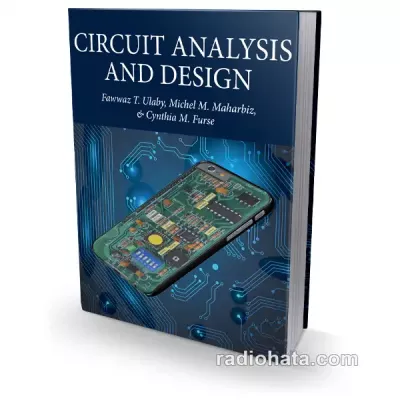
Circuit Analysis and Design, 3rd Edition
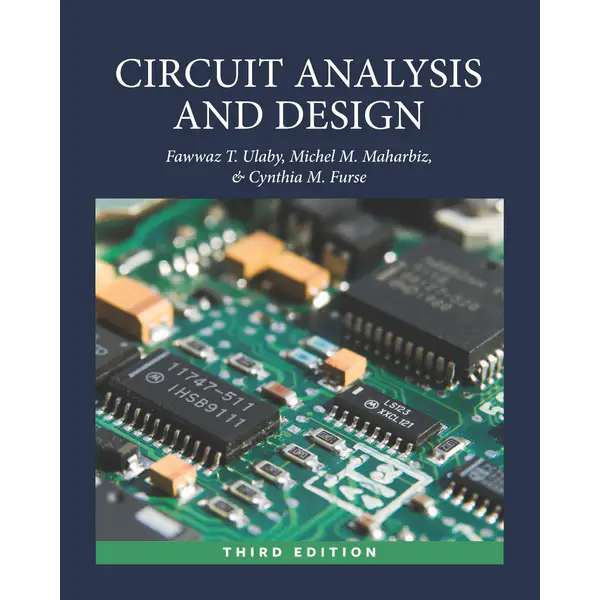
Circuit Analysis and Design, 3rd Edition by Fawwaz Ulaby, Michel M. Maharbiz, Cynthia M. Furse
English | 2025 | True PDF | 779 pages | 50.7 Mb
Welcome to Circuit Analysis and Design. As the foundational course in the majority of electrical and computer engineering curricula, an electric circuits course should serve four vital objectives:
(1) It should introduce the fundamental principles of circuit analysis and equip the student with the skills necessary to analyze any planar, linear circuit, including those driven by DC or AC sources, or by more complicated waveforms such as pulses and exponentials.
(2) It should start the student on the journey of circuit design.
(3) It should guide the student into the seemingly magical world of domain transformations—such as the Laplace and Fourier transforms, not only as circuit analysis tools, but also as mathematical languages that are “spoken” by many fields of science and engineering.
(4) It should expand the student’s technical horizon by introducing him/her to some of the many allied fields of science and technology.
(2) It should start the student on the journey of circuit design.
(3) It should guide the student into the seemingly magical world of domain transformations—such as the Laplace and Fourier transforms, not only as circuit analysis tools, but also as mathematical languages that are “spoken” by many fields of science and engineering.
(4) It should expand the student’s technical horizon by introducing him/her to some of the many allied fields of science and technology.
This textbook is intended to provide you with a solid foundation of the primary set of tools and mathematical techniques commonly used to analyze both direct current (DC) and alternating current (AC) circuits, as well as circuits driven by pulses and other types of waveforms. A DC circuit is one in which voltage and current sources are constant as a function of time, whereas in ac circuits, sources vary sinusoidally with time. Even though this is not a book on circuit design, design problems occasionally are introduced into the discussion as a way to illustrate how the analysis and synthesis processes complement each other.
This book aims to accomplish exactly those objectives. Among its distinctive features are:
Technology Briefs: The book contains 32 Technology Briefs, each providing an overview of a topic that every electrical and computer engineering professional should become familiar with. Electronic displays, data storage media, sensors and actuators, supercapacitors, and 3-D imaging are typical of the topics shared with the reader. The Briefs are presented at a technical level intended to introduce the student to how the concepts in the chapter are applied in real-world applications and to interest the reader in pursuing the subject further on his/her own. Technology Briefs cover applications in circuits, medicine, the physical world, optics, signals and systems, and more.
Application Notes: Most chapters include a section focused on how certain devices or circuits might be used in practical applications. Examples include power supplies, CMOS inverters in computer processors, signal modulators, and several others.
Multisim and MathScript: Multisim is a SPICE circuit simulator available from National Instruments (see cad.eecs.umich.edu for details). Multisim is highlighted through many end-of-chapter demonstrations. The student is strongly encouraged to take advantage of this rich resource. The Math-Script software can perform matrix inversion and many other calculations, much like the MathWorks, Inc. MATLAB software.
Contents:
Chapter 1 Circuit Terminology
Chapter 2 Resistive Circuits
Chapter 3 Analysis Techniques
Chapter 4 Operational Amplifiers
Chapter 5 RC and RL First-Order Circuits
Chapter 6 RLC Circuits
Chapter 7 AC Analysis
Chapter 8 AC Power
Chapter 9 Frequency Response of Circuits and Filters
Chapter 10 Three-Phase Circuits
Chapter 11 Magnetically Coupled Circuits
Chapter 12 Circuit Analysis by Laplace Transform
Chapter 13 Fourier Analysis Technique
Chapter 2 Resistive Circuits
Chapter 3 Analysis Techniques
Chapter 4 Operational Amplifiers
Chapter 5 RC and RL First-Order Circuits
Chapter 6 RLC Circuits
Chapter 7 AC Analysis
Chapter 8 AC Power
Chapter 9 Frequency Response of Circuits and Filters
Chapter 10 Three-Phase Circuits
Chapter 11 Magnetically Coupled Circuits
Chapter 12 Circuit Analysis by Laplace Transform
Chapter 13 Fourier Analysis Technique
Appendix A Symbols, Quantities, and Units
Appendix B Solving Simultaneous Equations
Appendix C Overview of Multisim
Appendix D Mathematical Formulas
Appendix E MATLAB and MathScript
Appendix F Answers to Selected Problems
Appendix B Solving Simultaneous Equations
Appendix C Overview of Multisim
Appendix D Mathematical Formulas
Appendix E MATLAB and MathScript
Appendix F Answers to Selected Problems
Download Circuit Analysis and Design, 3rd Edition

Похожие новости
Информация
Посетители, находящиеся в группе Гости, не могут оставлять комментарии к данной публикации.
-
Зарубежные журналы
-
Радиотехнические журналы
-
Книги

