Популярное
Электроника, электрика
Прием-передача
Электроника, электрика

Журнал Радиоконструктор

Электроника, электрика
Электроника, электрика
Микроконтроллеры
Funkamateur
Электроника, электрика
Справочники
Учебники
Электроника, электрика

Учебники
Электроника, электрика
Начинающему радиолюбителю
ESP32 TinyML Systems Engineering: Design, Optimize, and Deploy Production-Ready Edge AI with ESP32-S3, TensorFlow Lite Micro, Edge Impulse, Computer Vision, Audio, and Predictive Maintenance
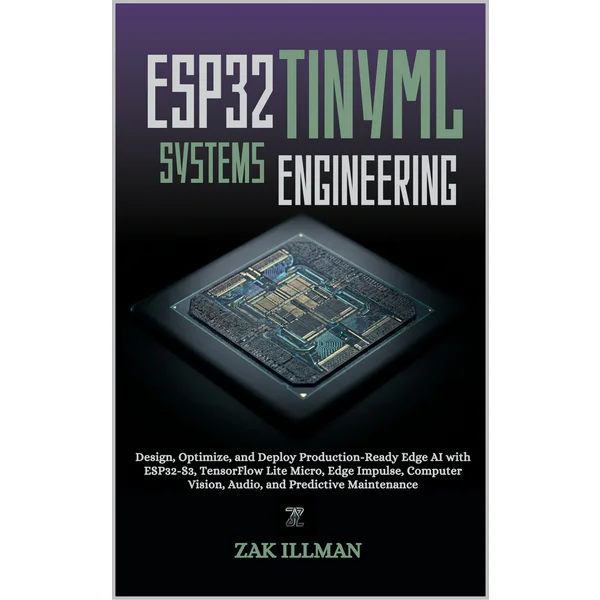
ESP32 TinyML Systems Engineering: Design, Optimize, and Deploy Production-Ready Edge AI with ESP32-S3, TensorFlow Lite Micro, Edge Impulse, Computer Vision, Audio, and Predictive Maintenance by Zak Illman
English | 2026 | EPUB | 16.7 Mb
Running an AI model on a microcontroller is one thing. Engineering an intelligent embedded system that remains fast, accurate, secure, power-efficient, and maintainable in the real world is another.
ESP32 TinyML Systems Engineering takes you beyond isolated Machine Learning demos and shows you how to design complete production-oriented Edge AI systems around the ESP32-S3.
Written for embedded developers, firmware engineers, IoT engineers, students, and serious makers, this practical guide connects Machine Learning with the engineering disciplines required to deploy it successfully on constrained hardware.
Build Embedded AI as a Complete System
You will work through the full lifecycle—from requirements, sensors, data collection, and model development to firmware integration, performance measurement, security, deployment, and long-term maintenance.
Understand the ESP32-S3 architecture and design reliable TinyML firmware with ESP-IDF and FreeRTOS
Build representative datasets and avoid leakage, poor labeling, and deployment-domain mismatch
Train, quantize, profile, and deploy compact models with TensorFlow Lite Micro / LiteRT for Microcontrollers
Use Edge Impulse as a professional embedded-ML development and optimization workflow
Engineer vibration, motion, and time-series classification systems
Build on-device audio intelligence, keyword spotting, and abnormal machine-sound detection
Deploy computer-vision pipelines for classification, detection, and visual inspection
Combine anomaly detection and fault classification for intelligent condition monitoring
Measure RAM, flash, tensor-arena usage, latency, throughput, energy per inference, and thermal behavior
Design resilient offline-first systems with MQTT, store-and-forward telemetry, watchdogs, and graceful recovery
Protect devices with Secure Boot, flash encryption, authenticated OTA updates, rollback, and release governance
A Production-Focused Capstone
Throughout the book, the concepts converge on a complete intelligent condition-monitoring node that combines sensor acquisition, vibration and acoustic intelligence, optional vision, local inference, decision logic, connectivity, diagnostics, security, and staged deployment.
You will learn not only how to make a model run, but how to prove that the entire system satisfies measurable requirements for predictive quality, memory, latency, energy, reliability, security, and maintainability.
Go Beyond Prototype-Grade TinyML
This is not a collection of disconnected AI experiments. It is a systems-engineering guide for readers who want to understand what happens between a successful prototype and a dependable embedded-AI product.
By the end, you will have a repeatable engineering framework for turning sensors, data, models, firmware, and ESP32-S3 hardware into intelligent edge systems built for real-world deployment.
You do not need prior TinyML experience. You should, however, be willing to work at the boundary between software and hardware. The most productive reader will be comfortable reading C/C++ syntax, using a command line, installing development tools, connecting a development board, and interpreting logs or error messages. Basic Python familiarity is helpful for model training and data work, but Python is treated as a means to build deployable artifacts rather than as the center of the book.
• Basic C or C++: variables, functions, structures/classes, arrays, pointers/references at a practical level, and reading library APIs.
• Basic electronics: voltage, ground, digital versus analog signals, and safe connection of common development-board peripherals.
• Command-line comfort: changing directories, running build commands, managing a project folder, and reading compiler output.
• Basic Git concepts are recommended so you can move between known-good chapter tags or commits in your project repository.
• No prior neural-network expertise is required. Core TinyML concepts are introduced in the context in which you need them.
Who This Book Is For:
The primary audience is the developer or engineer who wants to move beyond “it works on my desk” TinyML. You may already be comfortable with microcontrollers and be new to Machine Learning, or you may understand ML and need a more disciplined embedded-systems perspective. The early chapters establish a common foundation; the destination is professional practice.
Contents:

Download ESP32 TinyML Systems Engineering: Design, Optimize, and Deploy Production-Ready Edge AI with ESP32-S3, TensorFlow Lite Micro, Edge Impulse, Computer Vision, Audio, and Predictive Maintenance

Похожие новости
Информация
Посетители, находящиеся в группе Гости, не могут оставлять комментарии к данной публикации.
-
Зарубежные журналы
-
Радиотехнические журналы
-
Книги

